

The History of Porto Azzurro
from a small fishing village to the tourism of Elba Island
 The origins of Porto Azzurro can be traced back to the 1600s under Spanish rule, as depicted in the town's coat of arms. The coat of arms is divided into four parts. The first and fourth sections, in red, feature a castle with three towers and a gold star. The second and third sections, in silver, display a black anchor entwined with a green dolphin facing downwards.
The castle depicted in the coat of arms represents the Spanish fortress built by Philip III of Spain in the early 17th century, with the star indicating the top of the promontory. The dolphin symbolizes the earlier union with the community of Capoliveri under the name Lungone, later known as Longone or Porto Longone. Throughout its history, Elba witnessed numerous battles, resistances, and conquests. In 1646, French troops occupied the Forte di Portolongone, but the Spanish regained control a few years later.
The town developed below the Spanish fortress in an area known as "la marina." This location, ideal for cargo and refuge ships, was influenced by the passage of various foreign troops. The local economy thrived, particularly in agriculture and fishing, thanks to the mild climate. The territory passed to the Kingdom of Naples, remaining under its control until 1801, when Napoleonic troops took over, leading to Napoleon himself becoming "Sovereign of the Island of Elba." After Napoleon's fall in 1815, Elba became part of the Grand Duchy of Tuscany, eventually joining the Kingdom of Italy.
In 1947, after careful consideration and at the request of the residents, the town's name was changed from Portolongone to Porto Azzurro, marking the beginning of a new era more independent from the "Spanish Fortress," which had become a well-known penitentiary. Recognizing the presence of the prison, Porto Azzurro started developing its tourism industry in the 1950s and 60s, transforming, along with the rest of Elba Island, into a popular destination for thousands of Italian and international tourists.
Brief History of Porto Azzurro
Originally, the gulf that is now Porto Azzurro (renamed in 1947) was an important Roman and even Etruscan maritime port; the numerous archaeological finds discovered in its waters bear witness to this.
During the Middle Ages, information regarding "Portus Longe" (its earliest known name, likely derived from the extended shape of the inlet) is rather scarce. The only notable event is the arrival of the ship carrying Pope Gregory XI in 1376, following a sudden storm.

Throughout the 16th century, the waters of Longone were frequented by corsair ships seeking shelter from storms and to raid the few homes of farmers and fishermen living there. By the early 1600s, among the great European powers dominating the Mediterranean was the staunchly Catholic Spain, which, controlling the Kingdom of Naples, needed safe passage through the Piombino Channel. Recognizing the secure and spacious bay of Mola as an ideal harbor protected from winds and storms, King Philip III of Spain, who had already set his sights on it in 1595, ordered the Viceroy of Naples, Giovanni Alfonso Pimentel De Herrera, Count of Benavente, to construct a fortress near Longone. This fortress was intended to defend and protect Spain's military and commercial naval convoys.
The construction of the fortress, initially delayed by bureaucratic procedures and bad weather, began in May 1604, with excavations for moats and the erection of five large bastions connected by robust curtains. Within just two years, a formidable fortress complex measuring 1,700 meters internally and 2,500 meters externally was completed, designed in an irregular pentagon shape and made impregnable with demi-lunes, traverses, covered walkways, and moats.
However, due to spatial constraints and strict regulations (such as curfews preventing movement from sunset to dawn), part of the population moved to the marina area. Around the 18th century, the nascent village experienced significant population growth as Neapolitan and Genoese fishermen settled on the beach, immediately deciding to build a church dedicated to Madonna del Carmine (already documented since 1650).
Regarding religious buildings, aside from the Church of San Giacomo al Forte (completed in 1656), another symbol of Spanish rule on Elba was the sanctuary of Monserrato, established in 1606. Its construction was ordered by Joseph Ponce Y Lèon, a Spanish official and the first governor of Longone, enchanted by the valley's undeniable charm reminiscent of the similarly named monastery in Catalonia, Spain. The hermitage was home to numerous friars and hermits until the first half of the 19th century.
Adjacent to the Church of Carmine in the marina area is the small oratory of "Sacro Cuore di Maria," closely tied to local history.
Originally conceived as a funerary mausoleum for its founder, General Don Diego D'Alarcon, lieutenant of the Royal Piazza of Longone, it was built around 1727 near the old village cemetery by an architect of unknown identity, likely Spanish. Inside, the monument commemorates the General's virtues, qualities, and date of death. The funerary sculpture serves as a historical marker, reflecting the militaristic elements of cannons and drums that testify to the fortress's perpetual state of defense.
Spain permanently left the Longone fortress in 1735, though its condition deteriorated significantly, seemingly abandoned to a gradual decline. The Bourbons undertook extensive restoration and modernization works, recognizing that the walls had withstood three sieges (1646, 1650, and 1708).
On March 25, 1802, the Treaty of Amiens granted sovereignty over the entire island of Elba to France, which established Longone as its base and began issuing institutional measures through French General Commissioners P.J. Briot and J. Lelievre, prominent figures in the government.
Finally, the agreement of April 11, 1814, assigned the entire island to Napoleon, who governed it as a kingdom for about a year. Even within the Spanish Fortress, the exile had an apartment for "Longonesi stays." After Napoleon's departure and with the Treaty of Vienna, Elba returned to governance, and from 1816, the municipality of Longone (renamed Portolongone in 1873) included the territory of Capoliveri, officially dividing in 1907.
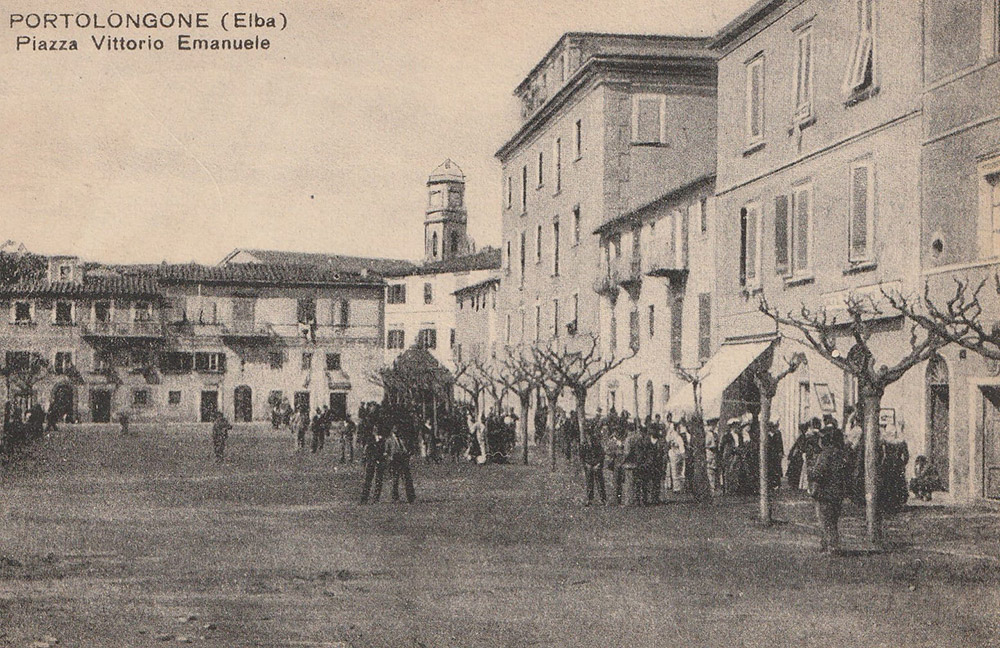
Unsent animated postcard - Ed. Piga Francesco
Therefore, it is not possible to assign a date.
Judging by the details of the ladies' clothing, who are nearby the current Bar Roma, one could venture a guess of late 1800s/early 1900s? Fun fact: There is another version of the same postcard, which differs in the writings (not in black ink, but colored) found beneath the image and along the right side.
246 PORTOLONGONE (Elba) - Piazza Vittorio Emanuele / By F.P. Portolongone (Pasquale Granata from the Facebook group "c'era una volta Porto Azzurro")
Porto Azzurro and the square, photo from the 1940s (Photo by facebook group "C'era una volta Porto Azzurro")
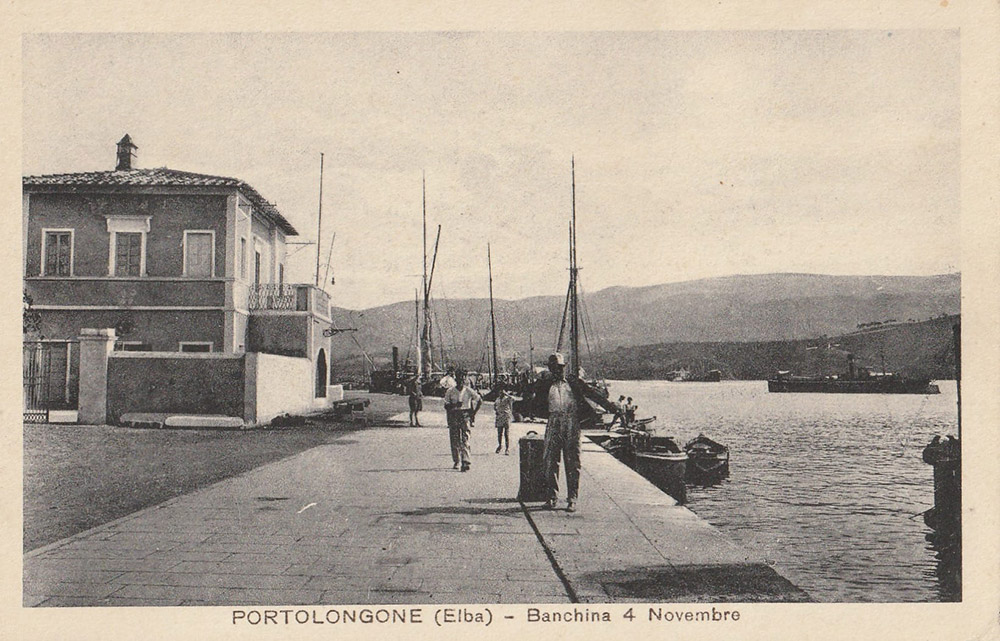
Portolongone - Banchina IV Novembre
Animated postcard, not used for travel. On the back, a date is enclosed in parentheses, which should be the date of issuance (1929).
Photo. A. Canale - Firenze.
(Propr. Pasquale Granata - photo by facebook group "C'era una volta Porto Azzurro")
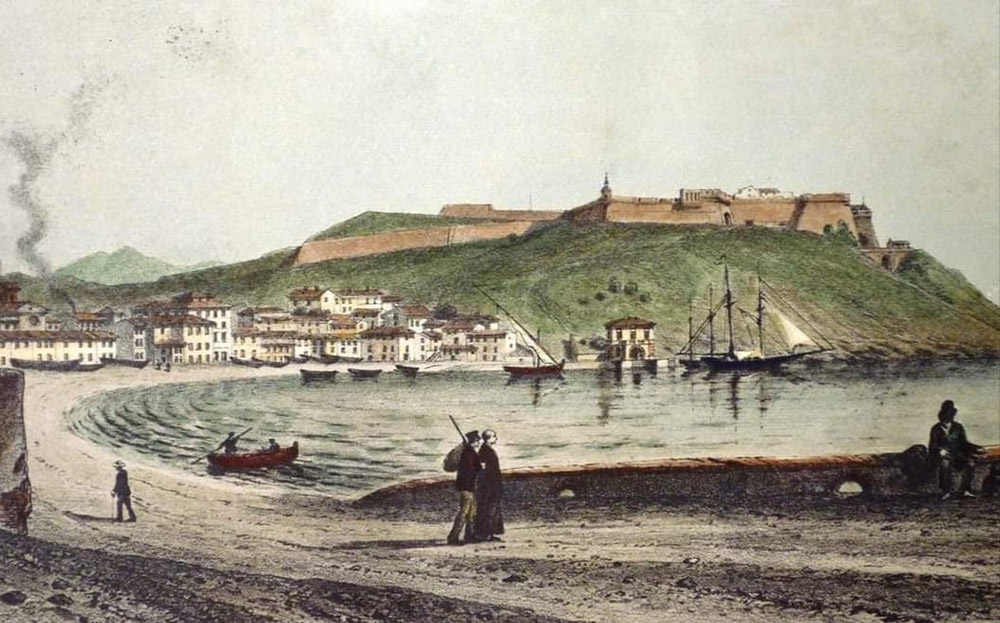
Pencil drawing from the early 1900s of Portolongone, now Porto Azzurro. (photo by facebook group "C'era una volta Porto Azzurro")
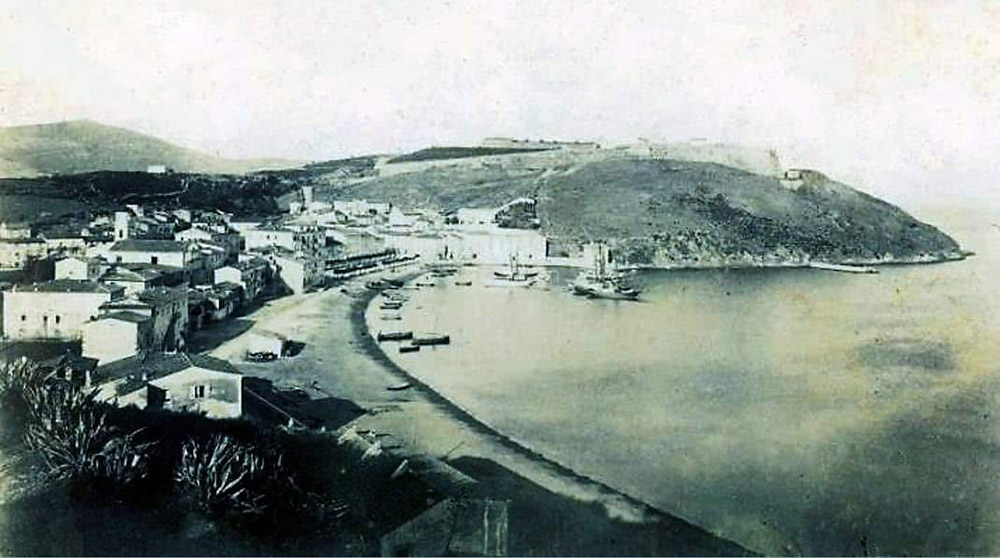
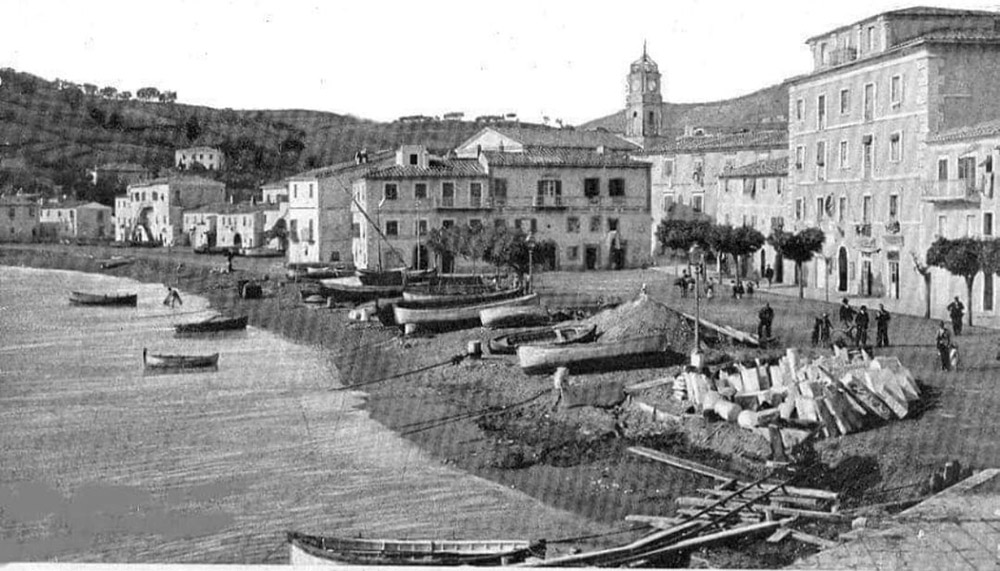
Photo from the early 1900s of Portolongone, now Porto Azzurro. (photo by facebook group "C'era una volta Porto Azzurro")
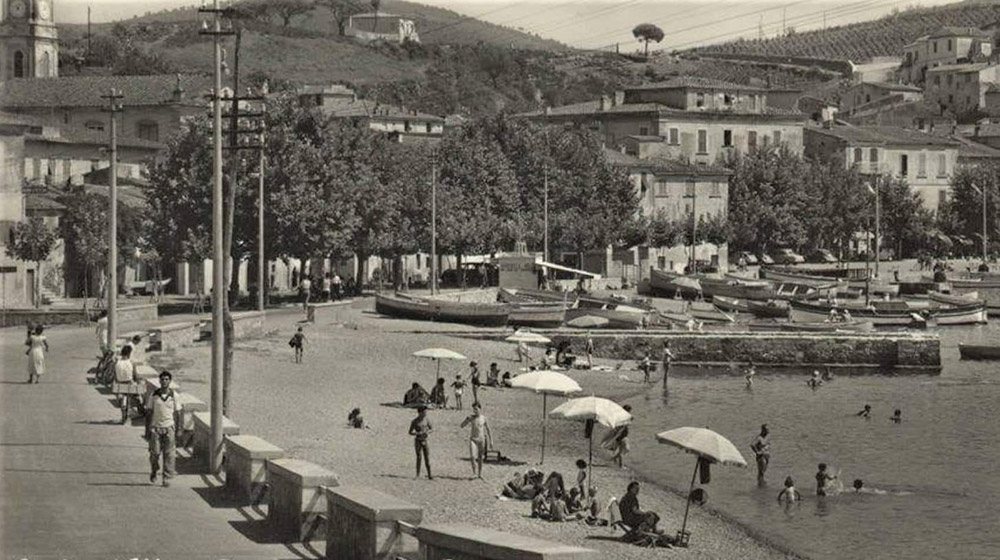
The beach of La Rossa reached all the way to the square, creating a very scenic view without the seafront restaurants on stilts.
(photo by facebook group "C'era una volta Porto Azzurro")
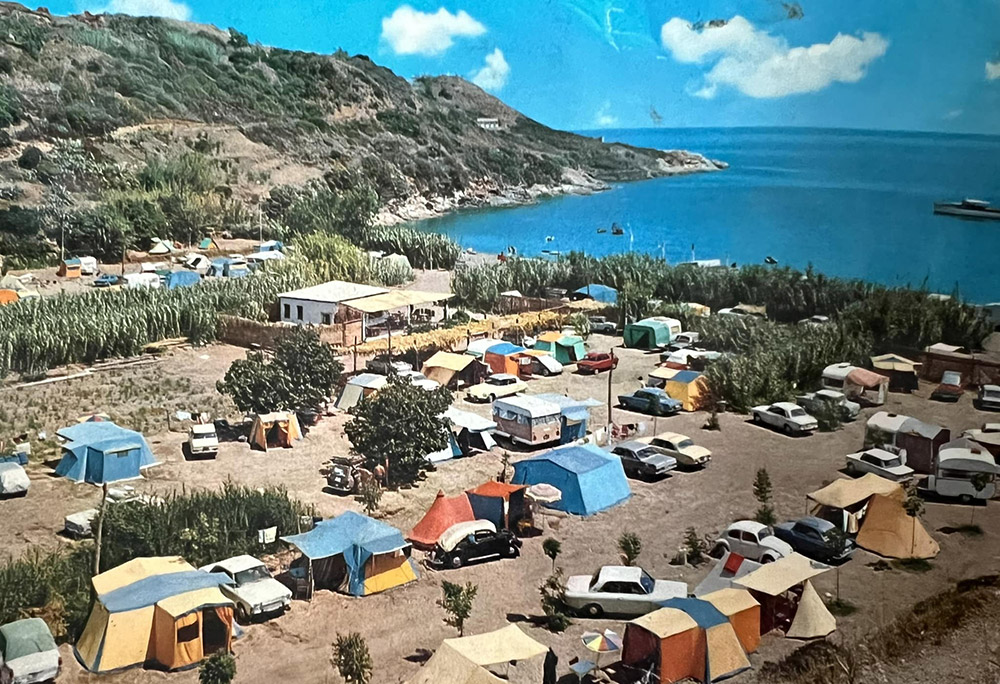
The Barbarossa beach in Porto Azzurro in the year 1968.
(photo by facebook group "C'era una volta Porto Azzurro")